 moneydiff.com
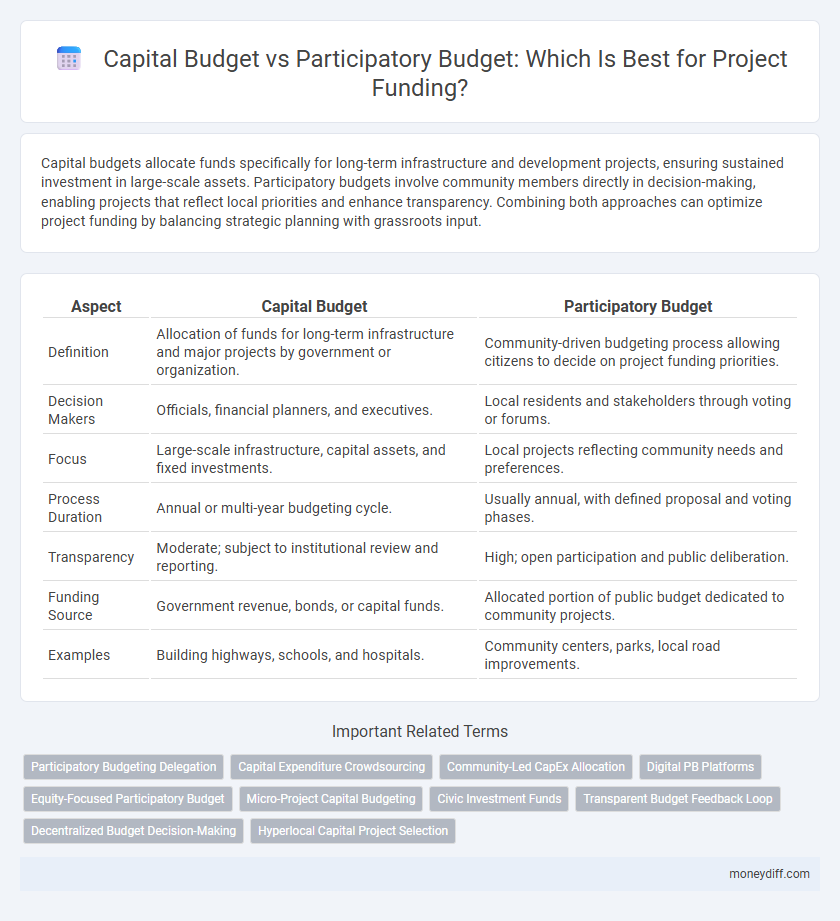
 Capital budgets allocate funds specifically for long-term infrastructure and development projects, ensuring sustained investment in large-scale assets. Participatory budgets involve community members directly in decision-making, enabling projects that reflect local priorities and enhance transparency. Combining both approaches can optimize project funding by balancing strategic planning with grassroots input.
Table of Comparison
| Aspect | Capital Budget | Participatory Budget |
|---|---|---|
| Definition | Allocation of funds for long-term infrastructure and major projects by government or organization. | Community-driven budgeting process allowing citizens to decide on project funding priorities. |
| Decision Makers | Officials, financial planners, and executives. | Local residents and stakeholders through voting or forums. |
| Focus | Large-scale infrastructure, capital assets, and fixed investments. | Local projects reflecting community needs and preferences. |
| Process Duration | Annual or multi-year budgeting cycle. | Usually annual, with defined proposal and voting phases. |
| Transparency | Moderate; subject to institutional review and reporting. | High; open participation and public deliberation. |
| Funding Source | Government revenue, bonds, or capital funds. | Allocated portion of public budget dedicated to community projects. |
| Examples | Building highways, schools, and hospitals. | Community centers, parks, local road improvements. |
Understanding Capital Budgeting for Project Funding
Capital budgeting for project funding involves evaluating long-term investments by analyzing potential costs and benefits to ensure optimal resource allocation. Unlike participatory budgeting, which incorporates community input to influence project priorities, capital budgeting relies on financial metrics such as Net Present Value (NPV) and Internal Rate of Return (IRR) to determine project viability. Effective capital budgeting ensures strategic investment decisions that align with organizational goals and maximize financial returns.
What Is Participatory Budgeting in Project Management?
Participatory budgeting in project management is a collaborative approach where stakeholders, including community members and project teams, actively engage in determining the allocation of project funds. This process contrasts with traditional capital budgeting by emphasizing transparency, inclusiveness, and shared decision-making, allowing for a more democratic distribution of resources based on collective priorities. By integrating participatory budgeting, project managers can enhance stakeholder commitment, improve project relevance, and ensure funding aligns with community needs and values.
Key Differences Between Capital and Participatory Budgets
Capital budgets allocate funds for long-term infrastructure and fixed asset projects, emphasizing strategic investments with predefined financial limits and timelines. Participatory budgets engage community members directly in decision-making, promoting transparency and collective prioritization of local projects to address immediate social needs. Key differences include the top-down approach and scale of capital budgets versus the inclusive, bottom-up process characteristic of participatory budgeting.
The Process of Developing a Capital Budget
The process of developing a capital budget involves identifying long-term investment projects, estimating costs, and prioritizing them based on financial feasibility and strategic importance. It requires collaboration among finance departments, project managers, and stakeholders to forecast capital expenditures and assess funding availability. Detailed cost-benefit analysis and risk assessment ensure that selected projects align with organizational goals and sustainable growth objectives.
How Participatory Budgeting Engages Stakeholders
Participatory budgeting empowers stakeholders by directly involving them in the decision-making process, allowing community members to propose and vote on project funding priorities. This collaborative approach enhances transparency and accountability, ensuring that allocated capital addresses the actual needs of the community. Engaging diverse voices through participatory budgeting fosters stronger support and more effective use of financial resources compared to traditional capital budgeting.
Pros and Cons of Capital Budgeting Approaches
Capital budgeting allocates resources for long-term infrastructure and major projects, offering structured financial planning and risk assessment but often lacks community input, which may lead to misaligned priorities. Participatory budgeting engages stakeholders directly, enhancing transparency and ensuring that funded projects reflect public needs, though it can be time-consuming and may result in fragmented funding decisions. Balancing the efficiency of capital budgeting with the inclusiveness of participatory budgeting can optimize project outcomes and resource allocation.
Advantages and Disadvantages of Participatory Budgeting
Participatory budgeting empowers community members to directly influence project funding decisions, fostering transparency and local engagement, which can result in more relevant and equitable public investments. However, this approach may face challenges such as limited participant expertise, potential dominance by vocal groups, and slower decision-making processes compared to traditional capital budgets. Despite these drawbacks, participatory budgeting enhances democratic governance by integrating diverse perspectives and increasing public trust in budget allocations.
Criteria for Choosing Between Capital and Participatory Budgets
Choosing between capital and participatory budgets depends on project scale, stakeholder involvement, and resource complexity. Capital budgets suit large-scale infrastructure projects requiring substantial, long-term investments with strict oversight. Participatory budgets are ideal for community-driven initiatives emphasizing transparency, local input, and smaller funding allocations to enhance civic engagement.
Case Studies: Project Outcomes Using Different Budgeting Methods
Case studies reveal that capital budgeting typically leads to long-term infrastructure projects with clearly defined financial metrics, ensuring efficient allocation of resources for large-scale investments. In contrast, participatory budgeting fosters community engagement, resulting in projects that better address local needs and enhance social equity, though with varied financial outcomes. Comparative analyses highlight that combining both methods can optimize project success by balancing technical feasibility and public priorities.
Best Practices for Integrating Capital and Participatory Budgets
Integrating capital and participatory budgets enhances project funding by aligning public investment with community priorities, ensuring transparency and accountability. Best practices include establishing clear criteria for project eligibility, fostering continuous communication between government officials and citizens, and employing data-driven decision-making tools to optimize resource allocation. This synergistic approach leverages capital funds' scale with participatory budgeting's inclusiveness to maximize social impact and infrastructure development.
Related Important Terms
Participatory Budgeting Delegation
Participatory Budgeting Delegation empowers community members to directly influence the allocation of funds within a capital budget, fostering transparency and inclusivity in decision-making processes. This collaborative approach contrasts with traditional capital budgeting by prioritizing public input and local priorities in project funding allocations.
Capital Expenditure Crowdsourcing
Capital budgets allocate funds for long-term investments in infrastructure and equipment, focusing on planned expenditures governed by organizational priorities, while participatory budgets engage stakeholders through crowdsourcing to democratically decide funding allocations, enhancing transparency and community involvement in capital expenditure decisions. Crowdsourcing in participatory budgeting leverages public input to identify and prioritize projects, potentially increasing the effectiveness and acceptance of capital investments by aligning them with community needs.
Community-Led CapEx Allocation
Capital Budget allocates funds for large-scale infrastructure and long-term assets, focusing on strategic investment managed by governing bodies, whereas Participatory Budget directly involves community members in decision-making, empowering local stakeholders to prioritize project funding that reflects their immediate needs and preferences. Emphasizing Community-Led CapEx Allocation enhances transparency, fosters civic engagement, and ensures that capital expenditures address the specific priorities of the community, driving equitable and sustainable development outcomes.
Digital PB Platforms
Capital Budget allocates funds for large-scale infrastructure and technology projects, while Participatory Budgeting (PB) involves community input in funding decisions, increasingly facilitated by Digital PB Platforms to enhance transparency and engagement. These platforms streamline proposal submission, voting, and feedback processes, enabling more inclusive and efficient allocation of public resources.
Equity-Focused Participatory Budget
Capital Budget allocates funds for long-term infrastructure projects based on administrative priorities, often limiting community input and reinforcing existing inequities. Equity-Focused Participatory Budget empowers marginalized communities by involving them directly in funding decisions, ensuring resources are distributed to address social disparities and promote inclusive development.
Micro-Project Capital Budgeting
Micro-project capital budgeting allocates financial resources specifically for small-scale infrastructure or community development initiatives, ensuring targeted investment in high-impact areas. Participatory budgeting engages local stakeholders in decision-making, enhancing transparency and prioritizing projects that directly address community needs within the capital budget framework.
Civic Investment Funds
Civic Investment Funds often utilize Capital Budgets to allocate resources for long-term infrastructure projects, emphasizing government-driven financial planning and asset management. Participatory Budgets, in contrast, empower community members to directly influence spending decisions, fostering transparency and local engagement in project funding.
Transparent Budget Feedback Loop
Capital budget allocates large-scale funding for infrastructure and long-term projects, while participatory budget engages community stakeholders in decision-making, enhancing transparency and trust; a transparent budget feedback loop facilitates real-time monitoring, accountability, and collaborative adjustments, ensuring funds are effectively utilized and aligned with public priorities. Transparent digital platforms and regular public reporting strengthen this feedback loop, promoting equitable resource distribution and responsive governance.
Decentralized Budget Decision-Making
Capital Budget allocates funds for long-term infrastructure projects with centralized control, while Participatory Budget engages local communities in decentralized budget decision-making, enhancing transparency and responsiveness to public needs. Decentralized budget decision-making empowers citizens to prioritize projects, fostering inclusive governance and more effective allocation of resources.
Hyperlocal Capital Project Selection
Capital budget allocates funds for long-term infrastructure and asset development projects, while participatory budget integrates community input to prioritize hyperlocal capital projects, enhancing transparency and local relevance. Hyperlocal capital project selection empowers residents to directly influence funding allocation, ensuring projects address specific neighborhood needs effectively.
Capital Budget vs Participatory Budget for project funding. Infographic